About Koyaanisqatsi
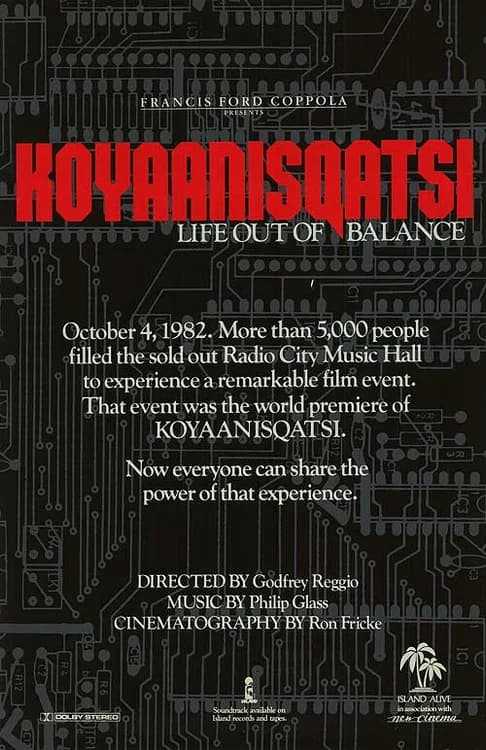
Godfrey Reggio's 1982 experimental documentary Koyaanisqatsi remains a landmark cinematic achievement that defies conventional categorization. Without dialogue, narration, or traditional plot, the film presents a mesmerizing visual symphony exploring the accelerating relationship between humanity, technology, and the natural world. Through breathtaking time-lapse photography, slow-motion sequences, and innovative cinematography by Ron Fricke, the film creates a powerful meditation on modern civilization.
The title, taken from the Hopi language meaning 'life out of balance,' perfectly encapsulates the film's central theme. We witness the majestic beauty of natural landscapes contrasted with the frenetic pace of urban environments, factory assembly lines, and technological proliferation. Philip Glass's iconic minimalist score provides the film's emotional and rhythmic backbone, creating a hypnotic experience that amplifies the visual narrative.
Koyaanisqatsi's enduring power lies in its ability to provoke thought without explicit commentary. The film invites viewers to draw their own conclusions about industrialization, consumerism, and environmental impact through pure visual poetry. Over four decades after its release, its themes feel more relevant than ever in our technology-saturated world. This is essential viewing for anyone interested in experimental cinema, environmental consciousness, or simply experiencing film as pure visual art. The complete absence of traditional narrative elements makes Koyaanisqatsi a uniquely immersive experience that continues to influence filmmakers and artists worldwide.
The title, taken from the Hopi language meaning 'life out of balance,' perfectly encapsulates the film's central theme. We witness the majestic beauty of natural landscapes contrasted with the frenetic pace of urban environments, factory assembly lines, and technological proliferation. Philip Glass's iconic minimalist score provides the film's emotional and rhythmic backbone, creating a hypnotic experience that amplifies the visual narrative.
Koyaanisqatsi's enduring power lies in its ability to provoke thought without explicit commentary. The film invites viewers to draw their own conclusions about industrialization, consumerism, and environmental impact through pure visual poetry. Over four decades after its release, its themes feel more relevant than ever in our technology-saturated world. This is essential viewing for anyone interested in experimental cinema, environmental consciousness, or simply experiencing film as pure visual art. The complete absence of traditional narrative elements makes Koyaanisqatsi a uniquely immersive experience that continues to influence filmmakers and artists worldwide.