About 1941
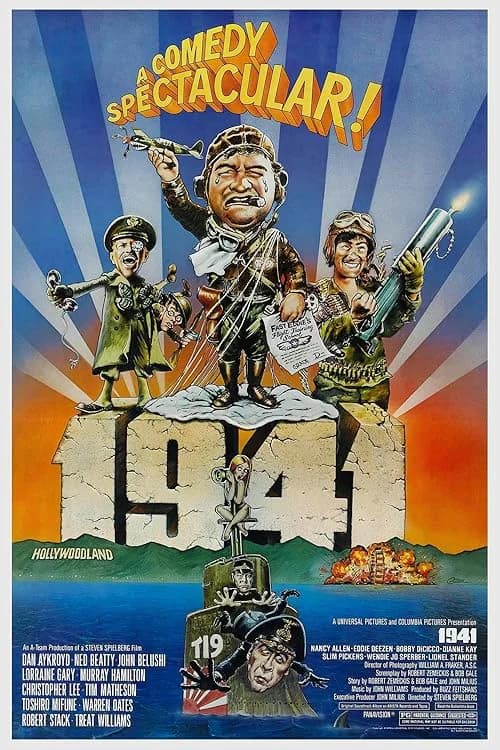
Steven Spielberg's 1941 (1979) represents a fascinating departure from the director's earlier blockbusters, offering a chaotic, star-studded satire of wartime panic. Set in the days following the Pearl Harbor attack, the film follows hysterical Californians who mistakenly believe a Japanese invasion is imminent, leading to absurd military maneuvers, civilian paranoia, and spectacularly misguided patriotism.
The ensemble cast delivers committed performances, with John Belushi as a crazed fighter pilot, Dan Aykroyd as a by-the-book sergeant, and Ned Beatty as a patriotic citizen whose backyard becomes a military installation. While the film's tonal shifts between slapstick comedy and wartime satire sometimes feel uneven, Spielberg's technical mastery is evident in elaborate set pieces, including a spectacular Ferris wheel collapse and chaotic aerial sequences.
Despite its mixed critical reception and modest 5.8 IMDb rating, 1941 has developed a cult following for its ambitious scale and willingness to experiment with comedy conventions. The film's production design and special effects remain impressive, showcasing Spielberg's visual storytelling even in comedic territory. For viewers interested in Spielberg's diverse filmography or unconventional war comedies, 1941 offers a unique viewing experience that balances historical context with outrageous humor, making it worth watching for both film historians and comedy enthusiasts seeking something different from typical war narratives.
The ensemble cast delivers committed performances, with John Belushi as a crazed fighter pilot, Dan Aykroyd as a by-the-book sergeant, and Ned Beatty as a patriotic citizen whose backyard becomes a military installation. While the film's tonal shifts between slapstick comedy and wartime satire sometimes feel uneven, Spielberg's technical mastery is evident in elaborate set pieces, including a spectacular Ferris wheel collapse and chaotic aerial sequences.
Despite its mixed critical reception and modest 5.8 IMDb rating, 1941 has developed a cult following for its ambitious scale and willingness to experiment with comedy conventions. The film's production design and special effects remain impressive, showcasing Spielberg's visual storytelling even in comedic territory. For viewers interested in Spielberg's diverse filmography or unconventional war comedies, 1941 offers a unique viewing experience that balances historical context with outrageous humor, making it worth watching for both film historians and comedy enthusiasts seeking something different from typical war narratives.